Dose COSELA prior to every chemotherapy infusion
Dosing 1

Dosing 1
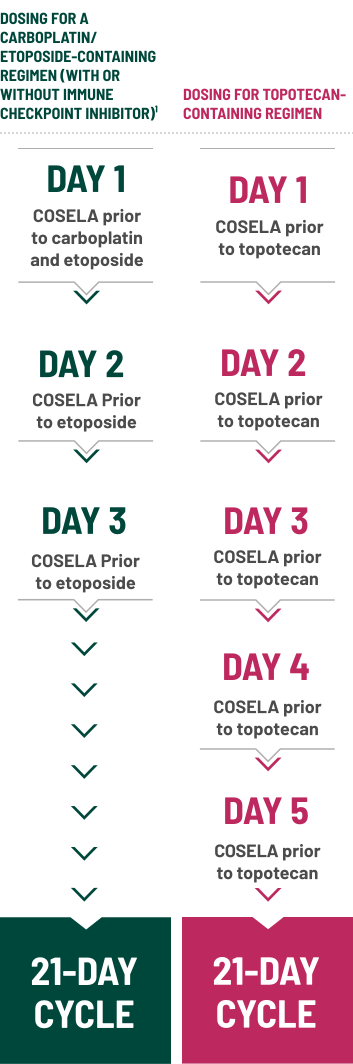
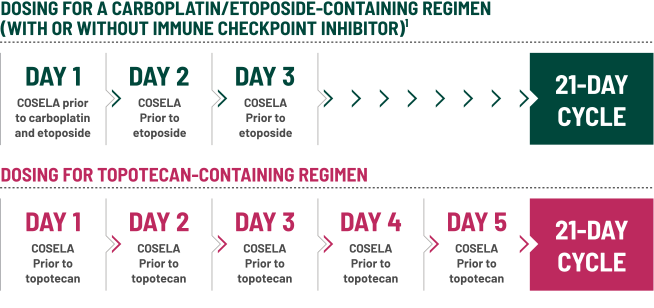
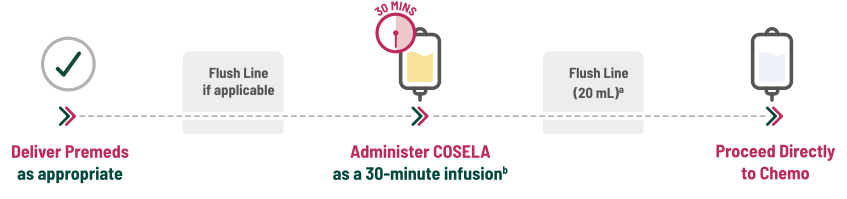
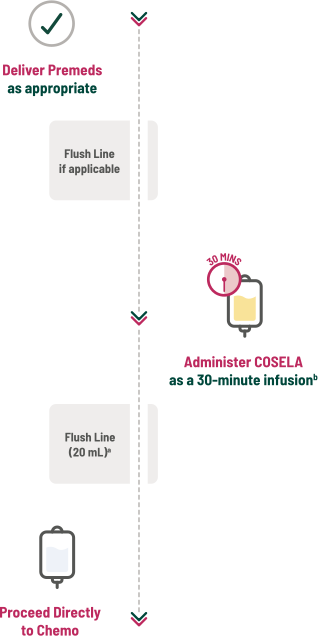
  • The recommended dose of COSELA is 240 mg/m2 per dose. Administer as a 30-minute intravenous infusion completed within 4 hours before starting chemotherapy on each day chemotherapy is administered1
    • Dosage forms and strengths: For injection: contains the equivalent of 300 mg of COSELA as a sterile, preservative-free, yellow lyophilized cake in a single-dose vial for reconstitution and further dilution
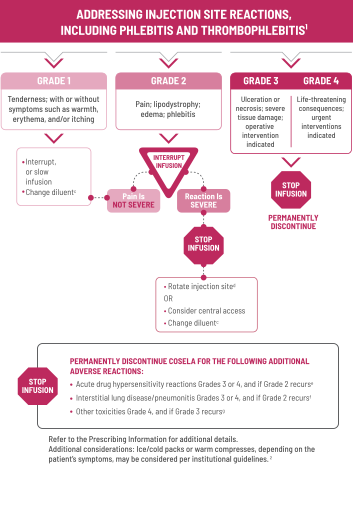
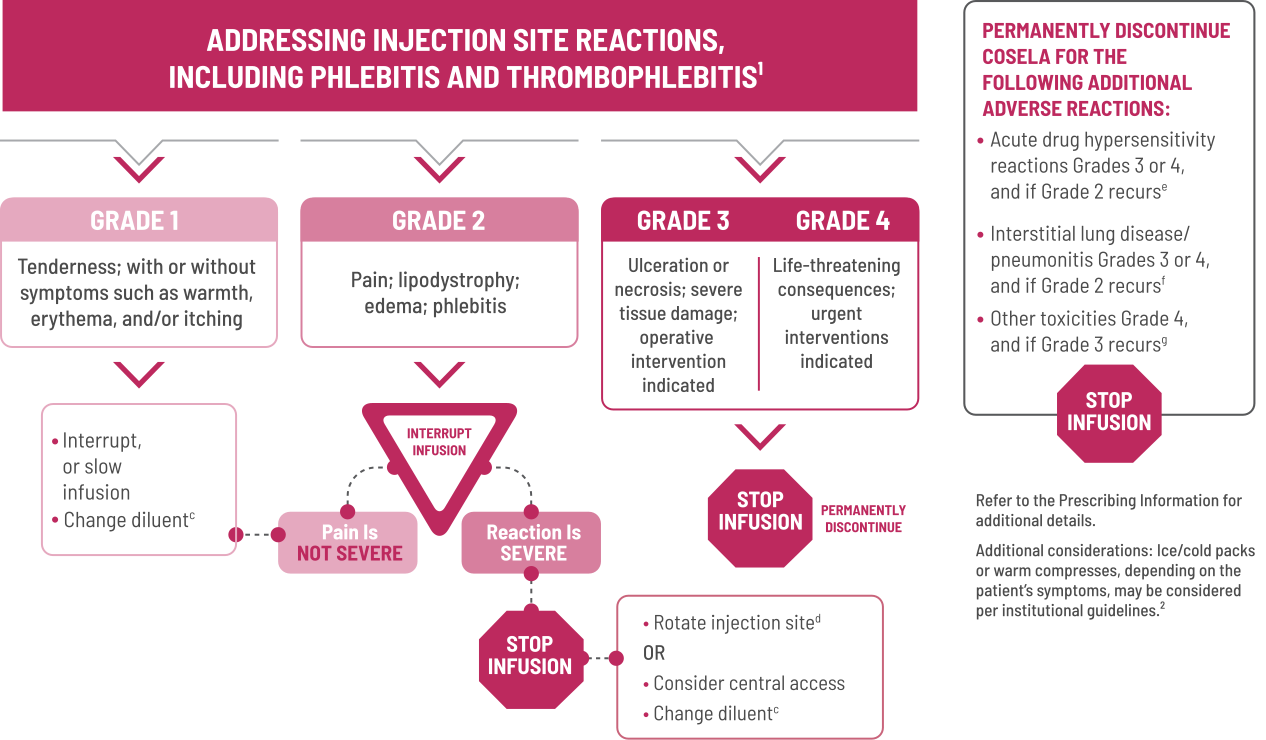
Monitor for signs and symptoms of injection-site reactions, including phlebitis and thrombophlebitis, during infusion. For severe or life-threatening reactions, stop infusion and permanently discontinue COSELA.
Dosing 1

Dosing 1

The interval between doses of COSELA on sequential days should not be greater than 28 hours

a Upon completion of infusion of diluted COSELA solution, the infusion line/cannula MUST be flushed with at least 20 mL sterile 5% Dextrose Injection, USP or 0.9% Sodium Chloride Injection, USP.
b COSELA can be given within 4 hours before chemotherapy.

Recommended actions for adverse reactions
Dosing 3

Dosing 3
  • If 0.9% Sodium Chloride Injection, USP is being used as a diluent/flush, consider changing to 5% Dextrose Injection, USP as appropriate for subsequent infusions1
  • Note that COSELA is not a vesicant
c Please see full Prescribing Information for additional diluent instructions.
d Stop infusion in extremity and rotate site of infusion to site in alternative extremity.
e Defined as: Grade 2=Moderate; minimal, local, or noninvasive intervention indicated; limited Activities of Daily Living. Grade 3=Severe or medically significant but not immediately life-threatening; hospitalization or prolongation of hospitalization indicated; disabling; limiting self-care Activities of Daily Living. Grade 4=Life-threatening respiratory compromise; urgent intervention indicated (e.g., tracheotomy or intubation).
f Defined as: Grade 2=Symptomatic. Grade 3=Severe symptoms; limiting self-care Activities of Daily Living; oxygen indicated. Grade 4=Life-threatening respiratory compromise; urgent intervention indicated (e.g., tracheotomy or intubation).
g Grade 3=Severe or medically significant but not immediately life-threatening; hospitalization or prolongation of hospitalization indicated; disabling; limiting self-care Activities of Daily Living. Grade 4=Life-threatening respiratory compromise; urgent intervention indicated.

Unexpected therapy interruption

The interval between doses of COSELA on sequential days should not be greater than 28 hours.1

Missed treatment session(s)1
  • If the COSELA dose is missed, discontinue chemotherapy on the day the COSELA dose was missed. Consider resuming both COSELA and chemotherapy on the next scheduled day for chemotherapy
Discontinuation of treatment1
  • If COSELA is discontinued, wait 96 hours from the last dose of COSELA before resumption of chemotherapy only
Image 1
Image 1
Image 1

IMPORTANT SAFETY INFORMATION

CONTRAINDICATION

  • COSELA is contraindicated in patients with a history of serious hypersensitivity reactions to trilaciclib.

To report suspected adverse reactions, contact Pharmacosmos Therapeutics at 1-888-828-0655 or FDA at 1-800-FDA-1088 or www.fda.gov/medwatch.

INDICATION

COSELA is indicated to decrease the incidence of chemotherapy-induced myelosuppression in adult patients when administered prior to a platinum/etoposide-containing regimen or topotecan-containing regimen for extensive-stage small cell lung cancer (ES-SCLC).

IMPORTANT SAFETY INFORMATION

CONTRAINDICATION

  • COSELA is contraindicated in patients with a history of serious hypersensitivity reactions to trilaciclib.

WARNINGS AND PRECAUTIONS

Injection-Site Reactions, Including Phlebitis And Thrombophlebitis

  • COSELA administration can cause injection-site reactions, including phlebitis and thrombophlebitis, which occurred in 56 (21%) of 272 patients receiving COSELA in clinical trials, including Grade 2 (10%) and Grade 3 (0.4%) adverse reactions. Monitor patients for signs and symptoms of injection-site reactions, including infusion-site pain and erythema during infusion. For mild (Grade 1) to moderate (Grade 2) injection-site reactions, flush line/cannula with at least 20 mL of sterile 0.9% Sodium Chloride Injection, USP or 5% Dextrose Injection, USP after end of infusion. For severe (Grade 3) or life-threatening (Grade 4) injection-site reactions, stop infusion and permanently discontinue COSELA. Injection-site reactions led to discontinuation of treatment in 3 (1%) of the 272 patients.

Acute Drug Hypersensitivity Reactions

  • COSELA administration can cause acute drug hypersensitivity reactions, which occurred in 16 (6%) of 272 patients receiving COSELA in clinical trials, including Grade 2 reactions (2%). Monitor patients for signs and symptoms of acute drug hypersensitivity reactions. For moderate (Grade 2) acute drug hypersensitivity reactions, stop infusion and hold COSELA until the adverse reaction recovers to Grade ≤1. For severe (Grade 3) or life-threatening (Grade 4) acute drug hypersensitivity reactions, stop infusion and permanently discontinue COSELA.

Interstitial Lung Disease/Pneumonitis

  • Severe, life-threatening, or fatal interstitial lung disease (ILD) and/or pneumonitis can occur in patients treated with cyclin-dependent kinases (CDK)4/6 inhibitors, including COSELA, with which it occurred in 1 (0.4%) of 272 patients receiving COSELA in clinical trials. Monitor patients for pulmonary symptoms of ILD/pneumonitis. For recurrent moderate (Grade 2) ILD/pneumonitis, and severe (Grade 3) or life-threatening (Grade 4) ILD/pneumonitis, permanently discontinue COSELA.

Embryo-Fetal Toxicity

  • Based on its mechanism of action, COSELA can cause fetal harm when administered to a pregnant woman. Females of reproductive potential should use an effective method of contraception during treatment with COSELA and for at least 3 weeks after the final dose.

ADVERSE REACTIONS

  • Serious adverse reactions occurred in 30% of patients receiving COSELA. Serious adverse reactions reported in >3% of patients who received COSELA included respiratory failure, hemorrhage, and thrombosis.
  • Fatal adverse reactions were observed in 5% of patients receiving COSELA. Fatal adverse reactions for patients receiving COSELA included pneumonia (2%), respiratory failure (2%), acute respiratory failure (<1%), hemoptysis (<1%), and cerebrovascular accident (<1%).
  • Permanent discontinuation due to an adverse reaction occurred in 9% of patients who received COSELA. Adverse reactions leading to permanent discontinuation of any study treatment for patients receiving COSELA included pneumonia (2%), asthenia (2%), injection-site reaction, thrombocytopenia, cerebrovascular accident, ischemic stroke, infusion-related reaction, respiratory failure, and myositis (<1% each).
  • Infusion interruptions due to an adverse reaction occurred in 4.1% of patients who received COSELA.
  • The most common adverse reactions (≥10%) were fatigue, hypocalcemia, hypokalemia, hypophosphatemia, aspartate aminotransferase increased, headache, and pneumonia.

DRUG INTERACTIONS

  • COSELA is an inhibitor of OCT2, MATE1, and MATE-2K. Co-administration of COSELA may increase the concentration or net accumulation of OCT2, MATE1, and MATE-2K substrates in the kidney (e.g., dofetilide, dalfampridine, and cisplatin).

To report suspected adverse reactions, contact Pharmacosmos Therapeutics at 1-888-828-0655 or FDA at 1-800-FDA-1088 or www.fda.gov/medwatch.

This information is not comprehensive. Please see the Full Prescribing Information.